
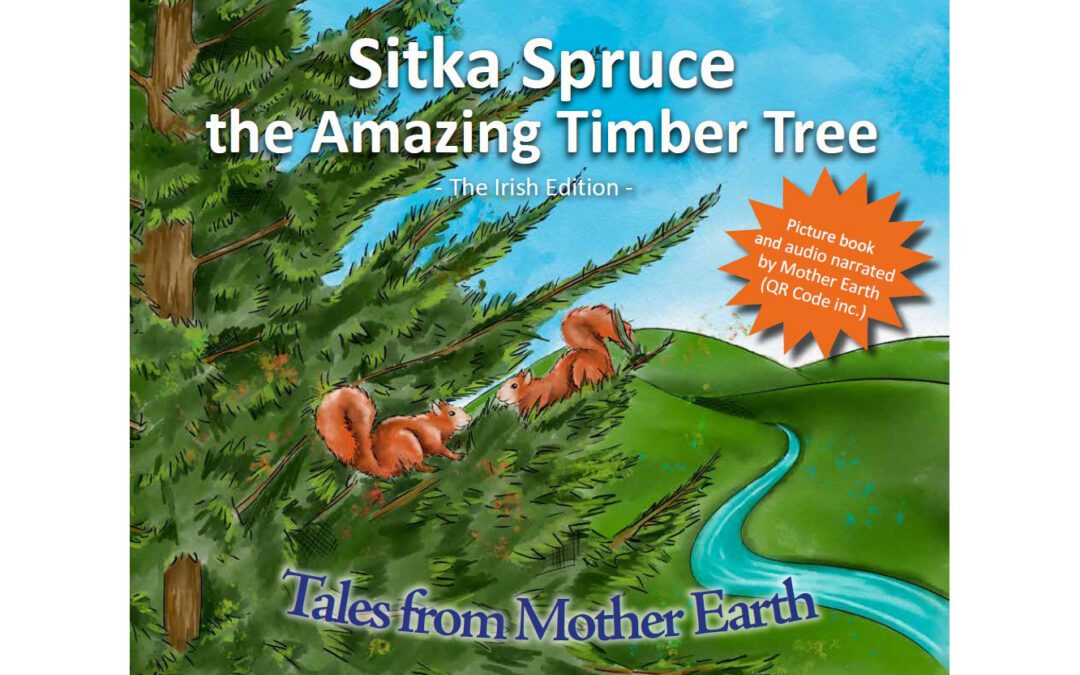
Sitka spruce, The Amazing Timber Tree, a book about Sitka spruce, “The most misunderstood tree in Ireland”, is being delivered to every primary school on the island of Ireland.
With support from The Society of Irish Foresters, SEEFA and the Irish Timber Council two copies of Sitka spruce, The Amazing Timber Tree, along with a digital version including a narrated story with sound effects are being sent to every primary school on the island of Ireland. Sitka spruce is the most important commercial, environmental and social tree species in Ireland. It is also the most misunderstood.
Foresters, forest owners and timber processors regard it as the most adaptable tree species growing in Ireland, capable of producing outstanding yields, on a variety of sites including low-nutrient soils and a wide range of end products. Other stakeholders regard it as a species that Irish forestry has become too reliant on. Speaking about the initiative, Joe Codd, PRO for the Society of Irish Foresters said “Sitka is a major species in Ireland’s Climate Action Plan especially in construction and energy where it displaces fossil based materials. It is also a key recreational species since Ireland adopted an open forest policy in the 1970s. Most of the annual 29 million visits to Irish forests are to Sitka spruce dominated recreation sites”
Teige Ryan, PRO for SEEFA explains “The book outlines how Sitka spruce is a vital tree in helping Ireland achieve carbon neutrality but also acknowledges its role in a balanced forestry programme alongside native, naturalised and exotic tree species. Sitka is often depicted as the only species in Irish forestry. While dominant, the current forest estate – public and private – comprises 45% Sitka, 16% diverse conifers, 24% native species, 4% non-native broadleaves and 11% mainly open biodiverse forest areas.”
Within this mix, Sitka spruce produces over 90% of all timber required and the wealth generation associated with the forestry and forest products industry.
“There are major challenges in Irish forestry including the management of Sitka spruce in sustainable landscape and ecosystem development. This book will help students better understand how Sitka spruce can shape Ireland’s landscape and how forestry – commercial and non-commercial – connects to science, geography, history, and the environment.” Details Niall Grainger representing the Irish Timber Council
This book will be a useful educational resource for the schools and will generate debate on sustainable forestry, which is a major resource in twenty first century sustainable living.